What should we train after those defenses
“What should they train?” after a battlefield means: on these holds, which layers returned something against what they would give up if wiped. It does not mean a tech tree, and it does not mean whichever layer got the most kills per troop.
By hand
You would copy every defending troop line — type, tier, killing, fallen, points given up — out of every hold, then roll that up. Higher tiers cost more points per troop if they fall. A layer that killed a lot can still be a poor thing to add if a wipe of that band is expensive. People do not finish that sheet. They remember who looked strong on the last report.
What becomes practical
Sit on a defense slice: one player’s defenses, main-only, or another cohort you can name. Ask which layers returned the most, and what the cost is if those troops are wiped out. Effectiveness nets return against that total-loss cost. You should still be able to see kills and points at risk separately. If you then split by the troop type that hit you, the same tier stops being one number.
The reading
This matrix is defender-perspective Effectiveness from a real set of holds. Each column is an incoming march or rally type, then the defending troop type. Each row is a tier. A cell is how that defending layer traded against that incoming type. Empty cells are combinations that were not in the sample.
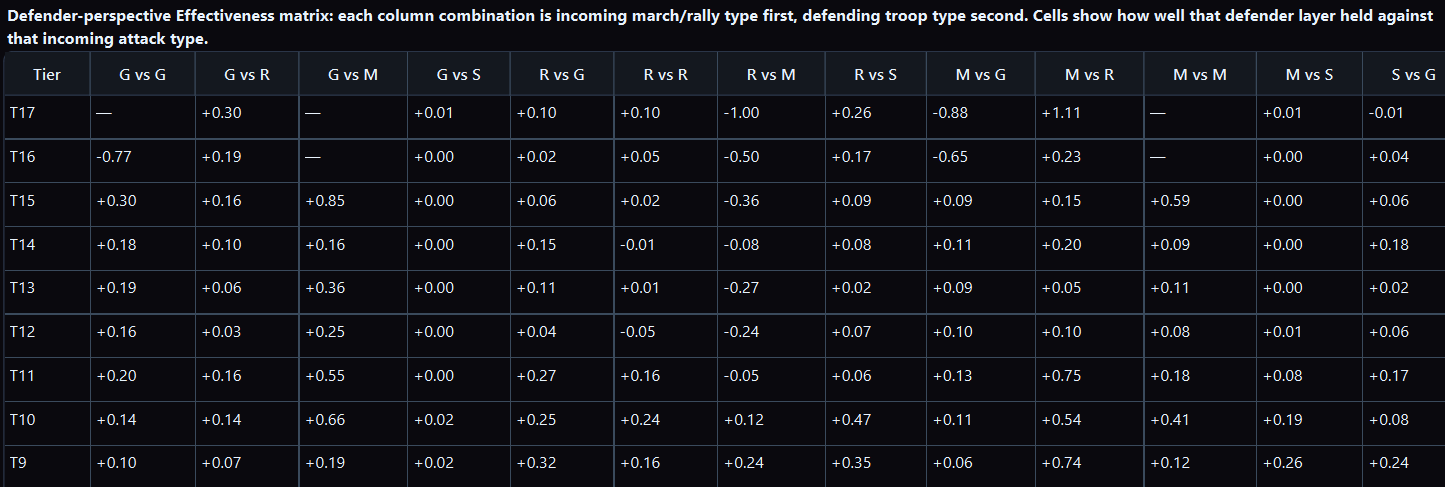
The useful fact in the grid is that a tier does not have one Effectiveness. Ground, ranged, mounted, and siege incoming are different columns. A band that holds in one column can give the points back in another. Training “more of whatever led the row” mixes those exams. Kills per troop are context. They are not the build order when the cost if those troops are wiped out is what you would actually pay.
A tiny band with a high cell is not automatically more important than a large-stake band with a worse number. Three fights are not a doctrine. If you are still on attacks, say so — this question is about the defenses you focused, not a silent flip to the other side.
Why it matters on the next battlefield
Training and healing priority for the next one is a decision with a cost. The scoreboard cannot show points given up, so it cannot show the downside of training more of an expensive tier that only looked good against one incoming type.
Ask it on yours
Import the battlefield. Focus the defenses you mean. Ask what they should train, or which layers returned the most, and the cost if those troops are wiped out, on these holds. If the answer might depend on what hit you, ask to split that same table by incoming type. Recipe: train more on a defense slice. Family: layers and train-more. The incoming split as its own question: how did we trade against one kind of incoming attack.
Ask it on the defenses you just fought.
The training argument is cheaper to have while those holds are the ones you remember, and the reports are favorited.
New customers can start with a 7-day trial. Plans start at $14.99/month with full feature access. The download is the installer; the account and trial come after you install.