How to measure the effectiveness of different troops in Evony
You already know who scored last night — the game ranks that. What you do not know is who gave points away to get there. Evony’s scoreboard does not show points given up, so it cannot tell you whether a march, a teammate, or a troop type actually traded well. Tactica Effectiveness is a cost–benefit metric for that missing half: what those troops returned relative to what they put at risk. Both halves are in the reports you already have.
What is Tactica Effectiveness?
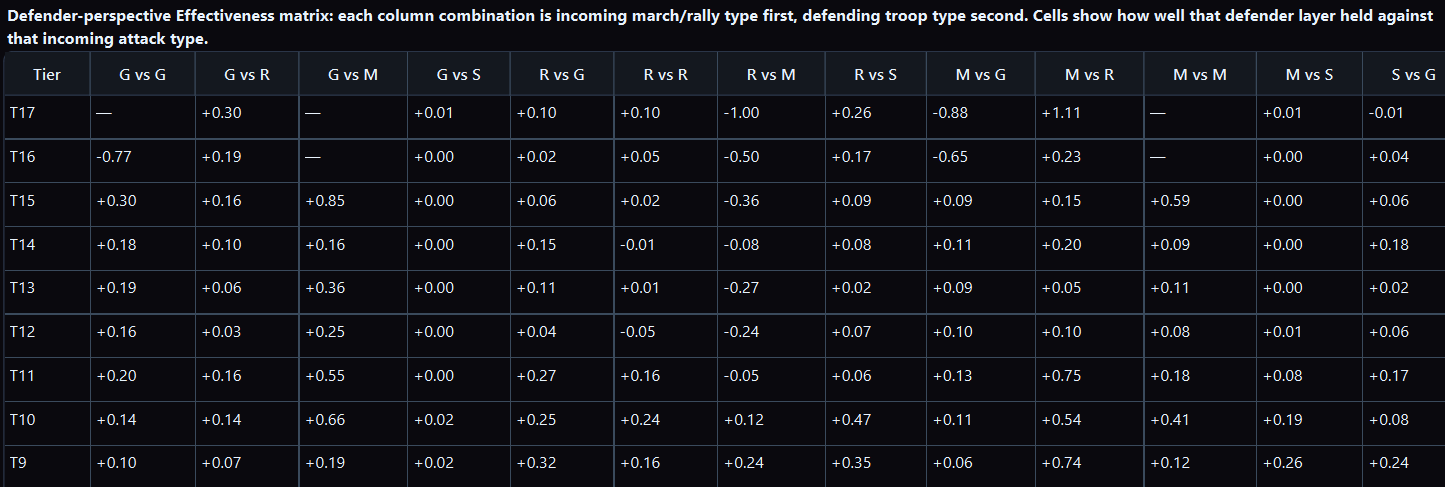
Effectiveness is Tactica’s risk-adjusted score for troops in a fight. It answers a different question from the scoreboard: not “who scored the most points,” but “what did this slice return against what it risked.” The slice can be a whole march, a teammate across defenses, or a band of troop types and tiers — for example Ranged T12–T14 versus Mounted T1–T4, or who traded best on ranged rallies.
Higher is better. There is no published “good” cutoff. The same formula is used for rally joins and for any other slice of a loaded battlefield. Effectiveness is not a reconstruction of the whole event scoreboard.
Scoreboard points are not the trade.
Effectiveness is the cost–benefit the in-game scoreboard does not show — across a loaded battlefield, not one fight. Your own last event is already enough data to compute it.
New customers can start with a 7-day trial. Plans start at $14.99/month with full feature access.
How is Effectiveness calculated?
In player language:
(approximate points scored − points given up) ÷ (points you would give up if those troops were a total loss)
Points given up are exact: fallen troops priced with the per-troop point table. The total-loss cost in the denominator is also exact: every troop in that slice priced as if it had fallen. Approximate points scored on a slice are a kill-share estimate — Evony reports how many enemy troops a line killed, not which tiers those kills were — so Tactica never calls Effectiveness “exact points scored.”
Because the denominator is priced from the actual tiers on the march, swapping T15 for T11 at the same headcount changes Effectiveness even when troop count looks unchanged.
How do I read an Effectiveness number?
Around zero is break-even on that risk-adjusted trade. Positive means a net return versus the downside of those troops. Negative means they conceded more than they scored against what they risked.
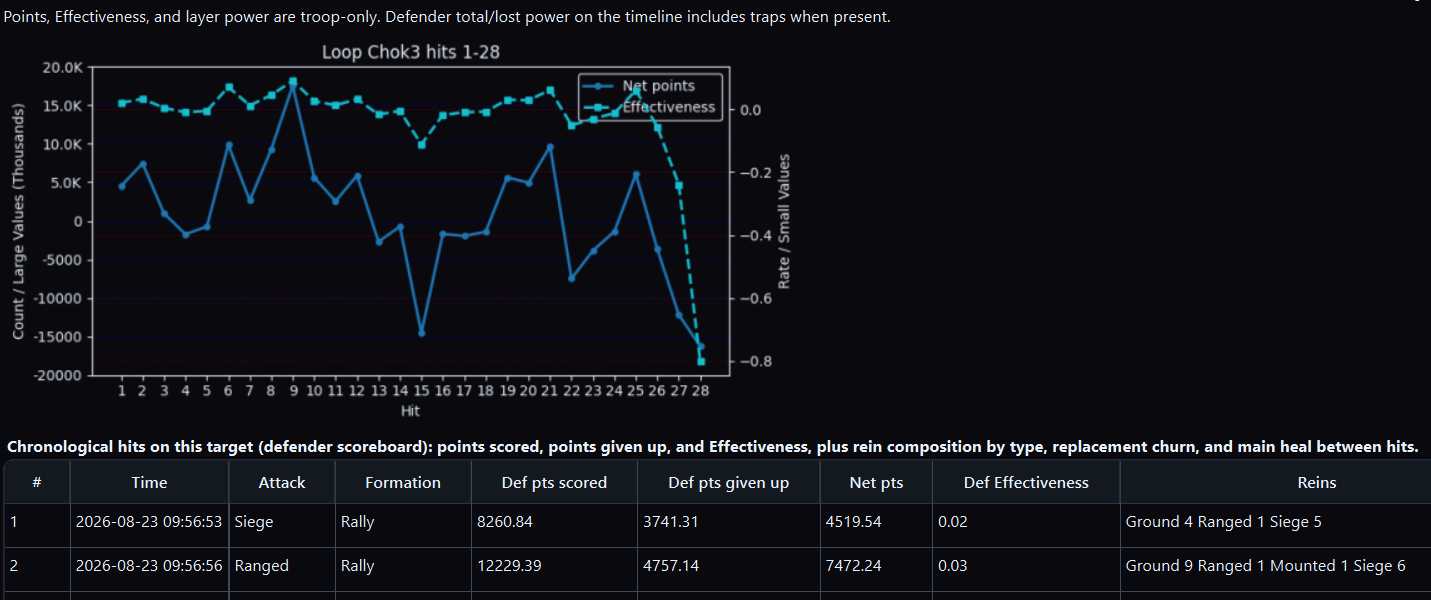
Cohort differences are often small. A few hundredths is still a ranking, not noise to ignore. Keep stake in view: a tiny slice with a high number is not automatically more important than a large-stake slice with a slightly worse number. Early setup hits can be negative and still useful — the metric is the trade, not a verdict that the hit was a mistake.
If the total-loss cost is zero or unavailable, Tactica shows no number rather than inventing one.
Why can a smaller march beat a larger one?
Effectiveness is return versus what that march put at risk, not total points scored. A smaller, cheaper march that trades well can outrank a huge one that scored more points but risked far more. That is the point of dividing by total-loss cost instead of ranking scoreboard points.
Is Effectiveness the same as points scored?
No. The in-game scoreboard shows points scored and does not show points given up. Raw score can therefore hide who traded efficiently. Effectiveness uses both sides of the trade. Points given up and total-loss cost are exact; points scored on a slice remain a kill-share estimate. Do not treat Effectiveness as exact points scored, and do not treat it as a rebuild of the whole scoreboard — unread reports, building points, and fights outside the loaded set stay out of view.
What is the difference between Effectiveness and Exchange Ratio?
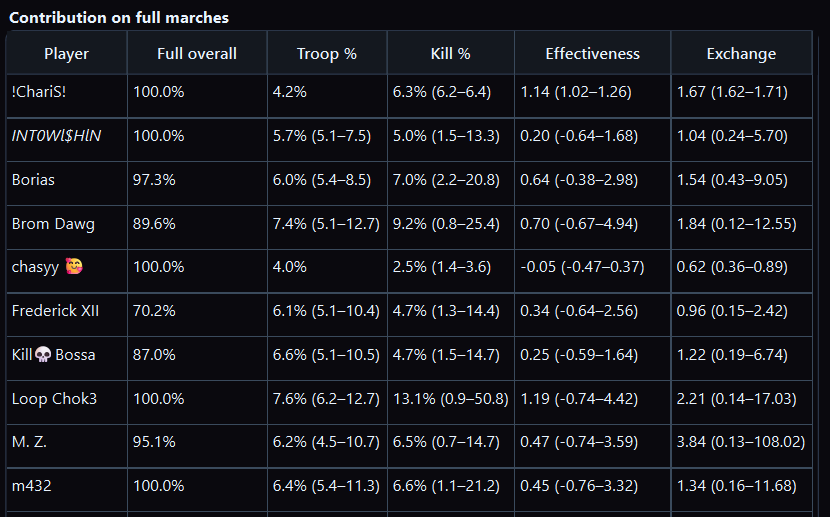
Effectiveness is that slice’s own cost–benefit against what it risked. Exchange Ratio is teammate-relative: that player’s share of the kills divided by their share of the points given up. Above 1.00 means they took a larger slice of the kills than of the losses their side conceded in that fight.
Because Exchange Ratio is shares within the same roster, it can move when a teammate joins with depleted troops (slang: dust) even if your own march did not change. Read it against the roster, not as a solo score. The old name “Effectiveness Ratio” is retired; that metric is now Exchange Ratio.
Full marches versus dust (depleted joins)
On rally joins, Tactica reports Effectiveness separately for full marches and for depleted (dust) joins after fall-off, plus the difference between those two. That is how you see whether someone still trades when they are sending dust, not only when the march is intact. Exchange Ratio is reported the same way, as supporting context — Effectiveness is the cost–benefit read; Exchange Ratio explains share versus teammates.
How do I see Effectiveness in Battlefield Analyst?
Import the battlefield’s reports into Tactica first. Then point Battlefield Analyst at that battlefield. It immediately summarizes what is there, so you are never flying blind. From that, follow its exploration or go custom in plain language — for example who traded best on ranged rallies, compare Ranged T12–T14 with Mounted T1–T4, or full joins versus dust. That is custom analysis over the structured library, not a fixed menu. Runtime is in minutes. Analysis is one battlefield at a time. Your reports stay in your Tactica library; the Analyst runs on that data in Tactica’s own systems.
If you want different arithmetic on the same library numbers, you can name a combination (plus, minus, times, divided by, constants) instead of using Effectiveness. Prefer Effectiveness when that is the trade you mean. You cannot invent the in-game scoreboard from kill counts. How to ask on a focused slice: Effectiveness on the current focus.
Who on your team actually traded well last night?
Import the event, focus the slice that matters, and use Effectiveness in the context of the fights around it. The names and the layers are already in those reports; this is the column nobody has been able to read off them.
New customers can start with a 7-day trial and begin reading reports within minutes. Plans start at $14.99/month with full feature access; higher-usage plans are available.
How Tactica works · FAQ · After-action review after a battlefield · Why one Evony battle report is not enough · How to analyze hundreds of Evony battle reports · Battlefield Analyst cookbook · Download Tactica