When did our rallies turn into dust
“They fell off” is what people remember. Headcount can hold while the tier mix rots. Headcount can drop because a march-size buff ended. Someone can heal and come back as a different march. Those are not the same event.
By hand
You need that player’s joins in order, with the layer mix, not a power column and not “they kept clicking.” Almost nobody builds that table for every teammate on one troop type. The room argues the vibe.
What becomes practical
Focus the team’s rallies of one type. The overview is who joined, who never fell off, and who fell off at a particular battle and minute. Open one name and the series is that player’s joins in order: size, mix, and what changed.
The reading
This team ranged-rally overview is from a real battlefield. Fell off is either none, or a battle number and how many minutes into the battlefield that drop happened. Still full after is the fraction of a full march they still had. Some names never fall off. Others drop early, with almost nothing left of a full march, or midway, still holding about half.
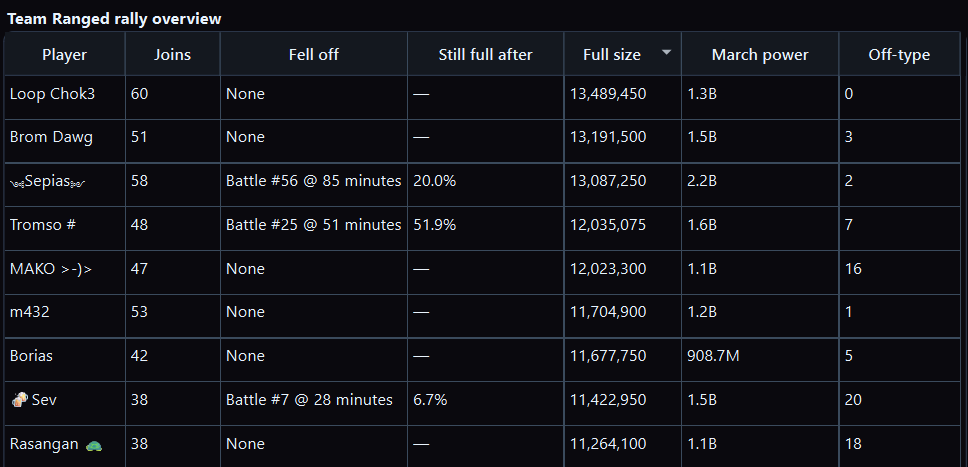
That table answers “when.” It does not yet answer “smaller march or worse fill.” That is the next cut: one player’s joins of that type, in order.
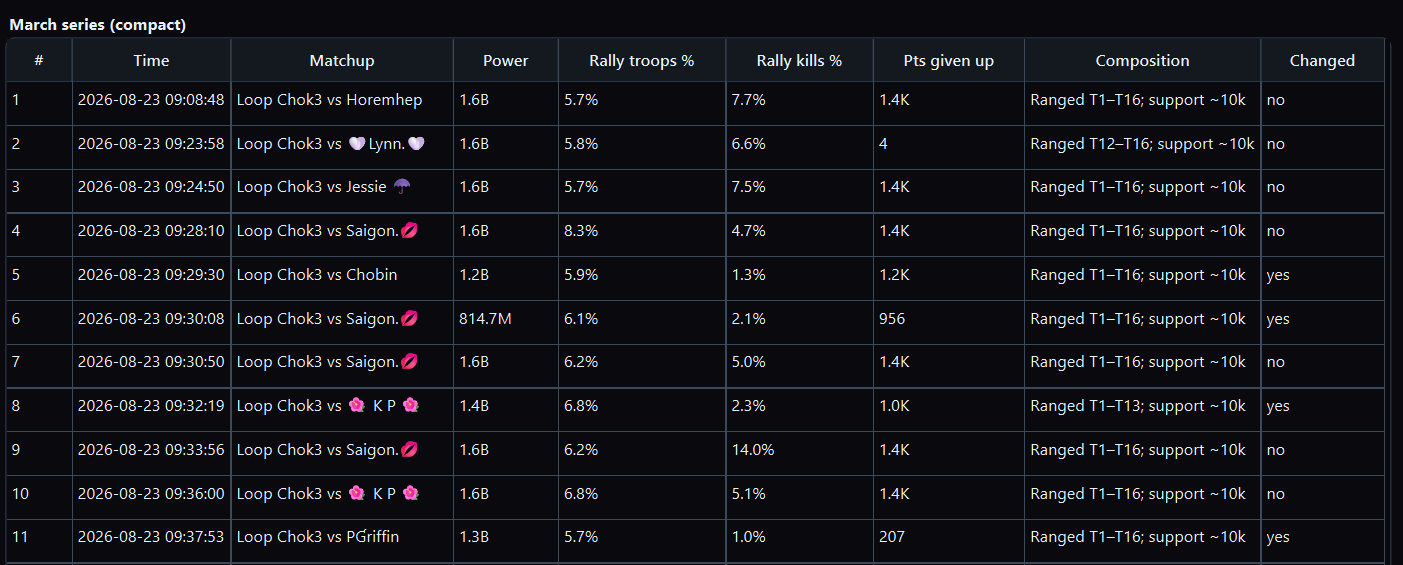

The narrative on this series separates three facts. Early on, some joins were the wrong troop type for these ranged rallies. Later, the top tier dropped — T16 toward T13 — which is a worse fill, not proof the march simply got smaller. After that, a heal brought top-tier troops back. Kill share moved with troop share, so the kill-share drop is not a verdict by itself.
A late small march is not “they never healed.” A power drop is not automatically a buff expiring. The series has to show which one it was.
Why it matters on the next battlefield
If the room thinks every march was depleted by the second hour, the overview either names the minute or it does not. If one player “threw,” the series either shows a rotten tier mix, a march-size drop, a rebound after a heal, or joins that were never the rally’s troop type. You call people back, or you stop calling them, based on which of those it was.
Ask it on yours
Import the battlefield. Ask for your team’s rallies of one troop type — ranged, ground, mounted, or siege. Then ask when each person fell off, and open the name you are actually arguing about: was the first drop a smaller march or a worse fill, and did they come back as the same march after a heal. Recipe: one player, then questions. Family: fatigue and substitution and team commitment.
This only sees joins that were imported. A short series can mean they sat, or that nobody favorited their reports. Players sometimes call a depleted march dust. Here it means the march is no longer full: the troops in it are used up, not a separate thing in the game.
Ask when your marches fell off.
The next battlefield is the one where “their marches were depleted” is either a minute and a tier mix, or still a vibe.
New customers can start with a 7-day trial. Plans start at $14.99/month with full feature access. The download is the installer; the account and trial come after you install.
All readings · Who actually traded well · Cookbook · Download Tactica