Which hits on that keep actually mattered
On a tear-down, the rally everyone remembers is often the one that scored. The hit that made the later rallies possible can be the one that looked ugly on its own exchange.
By hand
You open every report that touched that keep, write down the clock, whether it was siege, ranged, or mounted, what defender layers were left, and whether anyone healed between hits. Then you try to hold that sequence in your head. Teams do not do this. They remember the last hit and a couple of callouts.
What becomes practical
Once those reports are one library, Battlefield Analyst can sit on that keep and treat the imported hits as one experiment: same city, ordered time, the wall changing while your recipe repeats or shifts.
The reading
This is an attacker deconstruction from a real imported battlefield. Each row is one rally, in hit order. The tear path names the defender layers that rally wiped or cut — siege, mounted, ranged, ground, by tier. Setup Atk Eff is that rally’s own exchange. Later Atk Eff is whether the rallies after it got a better attacker exchange. Unlock marks that kind of hit. Experienced players know that one attack with limited success can open the way for the next attack to do far better than it would have on its own. Tactica lines those rallies up so you can see which hits did that.
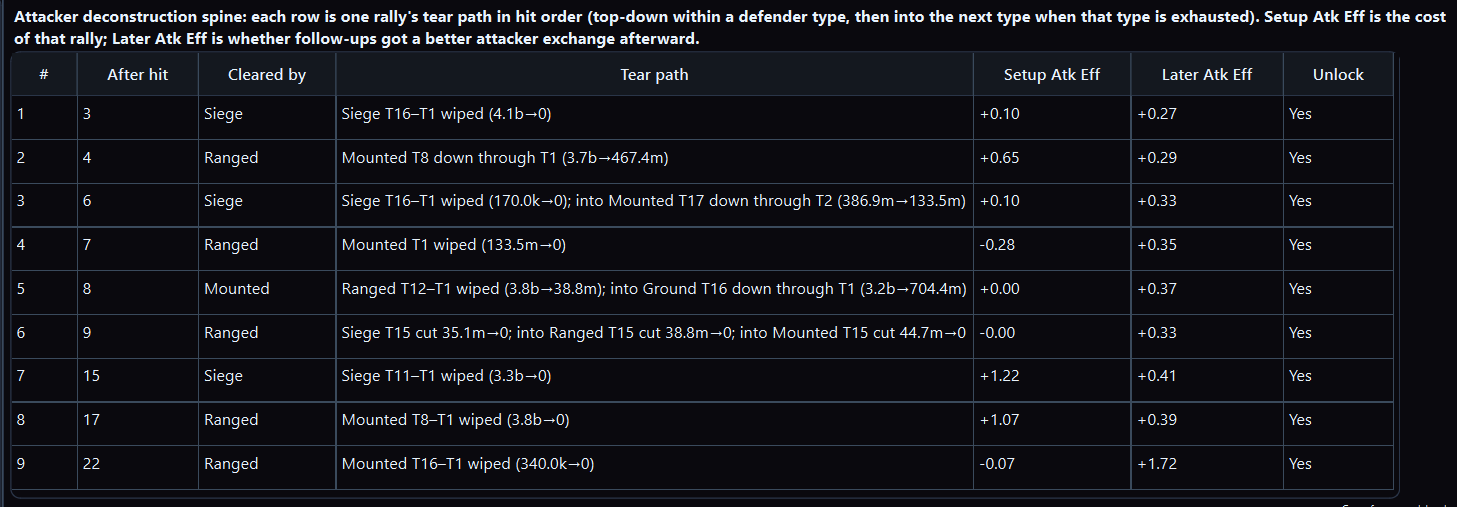
Several rows in this sequence are flat or negative on the rally’s own Effectiveness and still show a positive Later Atk Eff, with Unlock marked yes. Those are the hits a scoreboard argument throws out and a tear-down still needed: early siege and ranged that stripped a defender band so the rallies after them traded better. The last rows are the other shape — a rally whose own exchange is the story, because the wall it hit was already what the earlier tears left behind.
That split is the reading. “This rally scored” and “this rally made the next one possible” are different sentences. The second one is not a sum of points.
Why it matters on the next battlefield
The argument on voice is whether to keep sieging, switch to ranged, or send the same recipe into a wall that has already changed. You cannot settle that from the last report. You settle it from which hits paid for the ones after them.
Ask it on yours
Import that battlefield. Tell Battlefield Analyst you were tearing down that enemy keep. You may get the hit-sequence on the way in. Then ask which hits went negative on points and still stripped a layer the later rallies needed, and whether you kept sieging after that job was done. How to stay on the keep for the next question: one keep, then questions. The rest of this family: one keep as an experiment.
The sequence only includes reports in the library. A missing hit in the middle is a hole, not “nothing happened.” Points scored on a slice are a kill-share estimate. This is one battlefield, from the attacker side of that keep — a teammate’s city is a different vantage.
Walk your next keep the same way.
Install Tactica, create an account, and start the trial. After the next battlefield, favorite the reports and ask which hits mattered — while the callouts are still in people’s heads.
New customers can start with a 7-day trial. Plans start at $14.99/month with full feature access. The download is the installer; the account and trial come after you install.