Question atlas
This atlas is the large part of the cookbook. The core loop is how you drive. These pages are what it is worth driving toward.
They are curiosity families, not product SKUs. None of them is “the ranged report.” Each family is a cluster of questions that used to be too expensive to answer, and that the Analyst can take on once you have a focus.
Pick a family that matches what you actually wondered during the fight, even if you talked yourself out of it. The said in voice column is how that itch sounds on comms — same family, not a command to type. A useful next step is a named subset plus a specific question from that family — not “open Battlefield Analyst and summarize,” not a ribbon of buttons, and not exporting the library to finish somewhere else. Slices that get richer reporting are not the catalog of what exists. The families below are not the ceiling either: they are examples of curiosity. The ceiling is still any pile you can name, then an honest question on that pile.
How to use a family
- Name a subset.
- Take the post-focus summary.
- Ask one of the questions (any wording; the intent matters).
- Stay and split, or move to a tighter cut.
Many paraphrases are listed on purpose. The Analyst is not a phrase router. If two readings are possible, say the extra word.
Families
| Family | The itch | Said in voice |
|---|---|---|
| One keep as an experiment | The same city, hit after hit — what changed, what paid, what was wasted | What was happening to that keep between hits? |
| Rein economics | Who entered and left, swaps, missing layers, weak joins | Who was actually in that city, and who left? |
| Fatigue and substitution | Dust, tier mix vs headcount, rebound after heal | Were they still sending a real march, or just filling? |
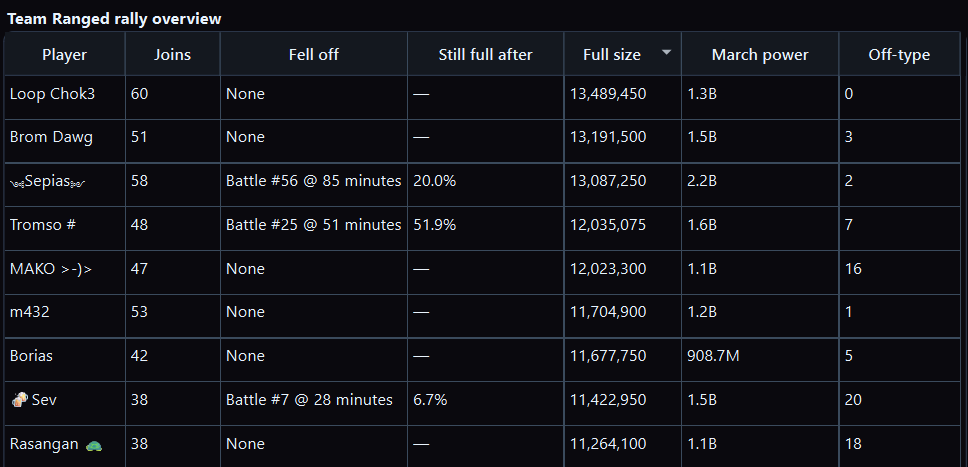
| Team commitment | Who held a full march, who fell off, who only sent layers or a small march | Did we show up with real marches, or only small ones? |
| Layers and train-more | Which layers to train more of — especially on a defense slice | What should they train after last night? |
| Main vs rein | Same player, different job | Was he good on his keep, or only when he reined? |
| Incoming-type splits | The same holds, cut by what hit you | Did we only get wrecked by one type? |
| Ugly-result forensics | Stake vs bad trade vs missing piece | Why did that one go so bad? |
| Coverage and sampling | Whose missing reports would change the story | Are we arguing from the fights we happened to have? |
| Near-replicates | Two hits that looked the same on our side while their wall had changed | Same rally twice — why was the second different? |
| Custom intersections | Piles that are not a common keep or team-type cut | Just the mains against their siege |
| Points, Effectiveness, exchange | Stop reading the scoreboard as cost–benefit | Who actually traded well — not who scored? |
What one of these found
- Which hits on that keep actually mattered — one keep
- Who was in the city when it held — reins, and main vs rein
- When did our rallies turn into dust — fatigue, and team commitment
- Who actually traded well on our rallies — points, Effectiveness, exchange
- What should we train after those defenses — layers and train-more
- How did we trade against one kind of incoming attack — incoming-type splits
Labor math behind why these were fantasies: Why this used to be impossible. How to cut the pile: naming a subset. What you can ask for in numbers: numbers and shapes. When the answer is a judgment, not just a grid: numbers, and the reading. Forms of answer (table, sequence, comparison): kinds of answers.
These itches only become answerable after the mailbox is a library.
Pick the family that matches what you wondered on voice. Then remember: without that battlefield’s reports in Tactica, the atlas is a reading list. With them loaded, it is a work queue you can finish in minutes.
New customers can start with a 7-day trial. Import one real event, then open the family you actually argued about. Plans start at $14.99/month with full feature access.