Numbers, comparisons, and table shapes
Once a subset is the current focus, you are not limited to denser reporting on the way in. You can ask for any of the measures below, at any grain down to a single layer, arranged in the row shape you want, plus lowest / typical / highest / spread across the fights (or layers) in that pile.
This is the part that used to be a weekend of opening reports into a sheet that still could not regroup. Say the measure and the shape in ordinary words. You do not need a report name.
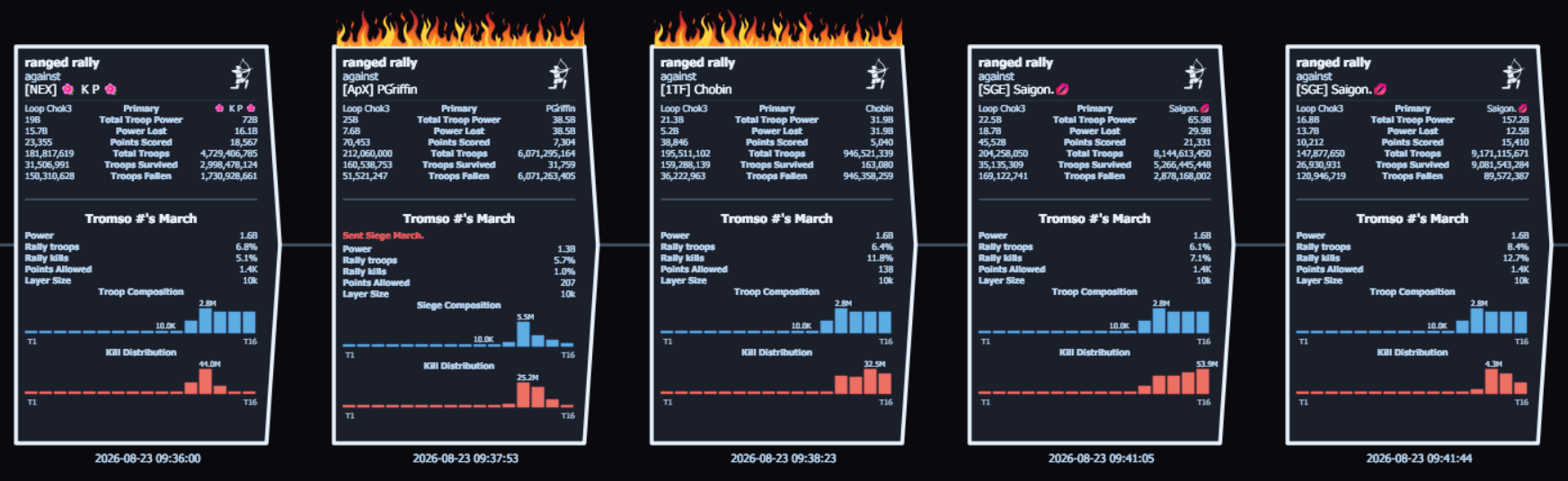
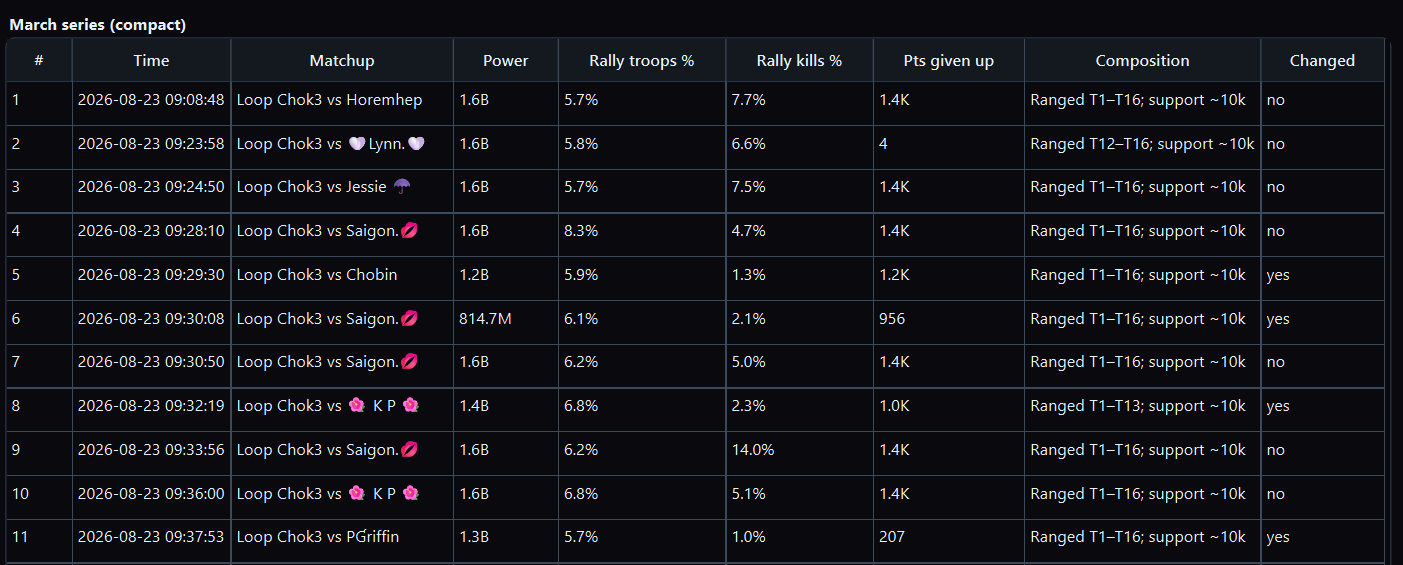
Measures you can ask for
These are rolled up from each layer (troop type + tier) in the reports in the current pile. You can keep them at the layer, or add them up to a type, a player, a fight, or the whole slice.
Counts and power
| Ask for | What it is |
|---|---|
| Troops fielded | How many troops that slice put on the field (survived plus fallen) |
| Survived | How many of those were still there at the end |
| Killing | Enemy troops that slice is credited with killing |
| Fallen | Own troops lost — killed, wounded, deserter, and holy palace as one total |
| Power fielded | Power of the troops that slice sent (before the fight) |
| Power lost | Power of the fallen troops |
The library still stores killed / wounded / deserter / holy palace on the report itself. The numbers you can table across a pile as first-class columns are the totals above.
Scoring
| Ask for | What it is |
|---|---|
| Points given up | Scoring points that slice conceded (tier-weighted fallen) |
| Points scored | Scoring points that slice is credited with — approximate on a slice (a share of the enemy’s points given up), not a reconstruction of the whole in-game scoreboard |
| Points you would give up if this slice were wiped | The total-loss cost of those troops — the stake in Effectiveness |
Built-in combinations
These are already defined. Prefer them when they are what you mean.
| Ask for | What it is |
|---|---|
| Survival | Survived ÷ troops fielded |
| Kills per troop | Killing ÷ troops fielded |
| Effectiveness | (points scored − points given up) ÷ the cost if those troops are wiped out. Higher is better. Around zero is break-even. |
| Exchange Ratio | Teammate-relative: kill share ÷ points-given-up share. Can move when a dusty teammate joins. |
On defense, you can also ask to include traps (Trap, Rock, Abatis, Fire Arrow) in the type breakdown. Say so; they are not in the default troop table.
Measures you define
You can name a new column from the library’s numbers. Combine them with plus, minus, times, divided by, and constants. You can nest those (for example, points scored minus points given up, then that result divided by the cost if those troops are wiped out). You can give the column a name. You can ask for lowest / typical / highest / spread on that measure the same way as a built-in.
Say it in ordinary words:
- Points scored minus points given up (net on that slice)
- Killing times 2, labeled “double kills”
- (Killing minus fallen) over troops fielded
- Points given up divided by the cost if those troops are wiped out
- “Call it net per potential” when you want your name on arithmetic that looks like Effectiveness
Prefer the built-in combinations when they already are what you mean. A named formula is still computation. What it means for the next set is the reading.
If a number is approximate (points scored below the whole side), the Analyst should say so. A divide that is undefined shows no number, not a zero.
What this is not: inventing data the reports do not have, and not “turn kill counts into the in-game scoreboard.” The pieces have to be library measures (or a constant). You can put a few named formulas on one ask.
Lowest, typical, highest, spread
Across the observations in the pile — usually each fight, or each layer, or each player’s fights — you can ask, for any built-in or named measure:
- How many observations
- The lowest
- The mean (typical when they showed up — each fight counts equally)
- The highest
- How spread out the numbers were (the population spread of that pile)
Example: “On her main defenses, Effectiveness of T12+ ranged: mean, min, max, and how spread it was.”
You can get that overall, or broken out (each player, each troop type, each tier, whether the target was cleared, incoming attack type).
Grain: down to the layer
A layer is one troop type at one tier (Ranged T14, Ground T12, …).
You choose how fine to go:
- The whole current pile as one row
- One row per player
- One row per fight
- One row per troop type
- One row per tier
- One row per layer (type and tier together)
You can also filter a band and still roll up: “each player’s T12 and above only,” “mounted T1–T4 vs ranged T12–T14 on this defense pile.”
That is how train-more and “which layers did the work” become a table instead of a memory.
Shape of the table
You pick the rows and the splits. The same numbers can be a player list, a fight list, a type comparison, a layer grid, or a “same look, but one block per incoming type.”
Useful shapes to name out loud:
- One row per teammate, numbers added up across their fights in this pile
- One row per fight, then who was in it
- One row per troop type (or per layer), across the whole pile
- The same table, split by target cleared vs not cleared
- The same table, split by what type hit us (or what type we sent)
- Early window vs late window as two piles, or as a filter then a rebuild
If the first table is the wrong shape, say the shape you want. That is a stay-on-focus ask, not a new product. Copy button is on the table; there is no dump of the whole library.
What a good ask sounds like
- “Table of Effectiveness by player on this pile, T12+ only.”
- “Same numbers, but one row per layer.”
- “Min, mean, max killing per fight for our ranged rallies.”
- “Points scored minus points given up, by incoming type.”
- “(Killing minus fallen) over troops fielded, by player — call it net kill rate.”
- “Include traps on this defense breakdown.”
Common miss
Asking for a precise layer table while the focus is still the whole battlefield. Cut first, then shape the numbers. Curiosity about what to ask: question atlas.
The table is the computation. If you want a judgment on it (what to train, why the ugly result, whether the drop was dust), say so. Numbers, and the reading.
Layer tables used to be a weekend. Now they are a stay-on-focus ask.
Any measure, down to a layer, in the row shape you name — that only works when the battlefield is already structured. Cut the pile first, then ask for min / mean / max, a layer grid, or a formula you define. The trial is how you stop rebuilding that sheet by hand.
New customers can start with a 7-day trial. Plans start at $14.99/month with full feature access.