Numbers, and the reading of the numbers
The Analyst does two different jobs. Mixing them up is how people flatten it into “a calculator with chat.”
Computation is the table: fielded, killing, points given up, Effectiveness, min / mean / max, a layer grid, a combination you defined (plus, minus, times, divided by, a constant). Those numbers were always in the reports. The product makes them reachable in minutes. Numbers and shapes.
Reading is the writeup that decides what those numbers mean for the question you asked — and what they do not mean. That is reasoning about the fight, not a second arithmetic pass.
You asked for a table; you should still get the table. The reading is what tells you whether the high number is a tiny sliver, whether a kill leader is a bad train, whether a power drop was dust or a buff falling off, whether the ugly result was stake or a missing rein.
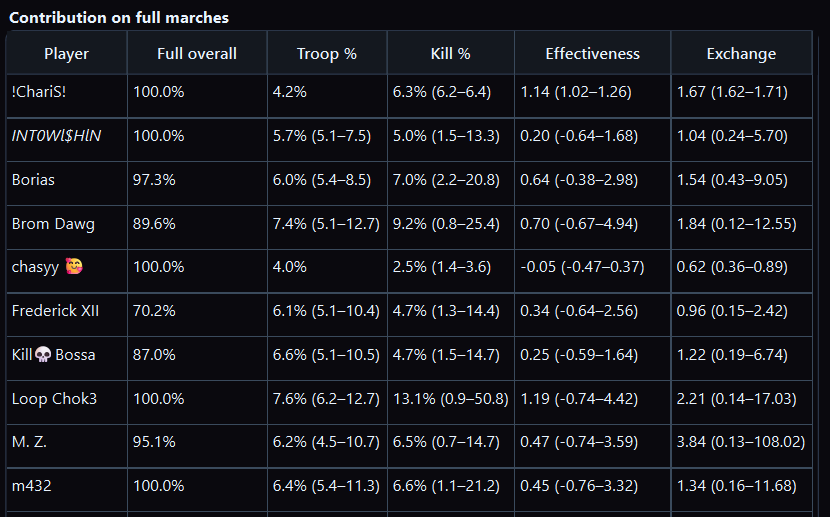

Where the reading shows up
These are the same loop. They are not extra modes.
| When | What the reading is doing |
|---|---|
| First battlefield summary | What is worth time, and what is thin in the sample — not a dump of every fight |
| Summary after you change subset | Confirm you landed, and what stands out from here |
| Train-more on a defense slice | Weigh kills those layers got against points those layers put at risk if wiped. Computation can list both. The recommendation is the tradeoff. |
| One keep | Which hits paid for later ones, which were wasted, what changed in the gap — heal vs reins leaving vs port |
| Fatigue | Dust (worse mix, size held) vs a march-size buff falling off vs a heal rebound. Power going down is not one story. |
| Ugly result | Stake vs bad trade vs missing layer or missing rein |
| Coverage | Missing reports are not “it didn’t happen.” A confident blame from eight fights is a bad reading. |
| Team commitment | Who held, who only sent layers or a small march, who only looks good because someone else was dust |
| Near-replicates | Same attack composition, different defending city — memory vs lined-up compositions |
| After a custom table | What the columns imply for this ask, and one honest next cut — not a restatement of every cell |
What a good reading does not do
- Recite the table you can already see
- Treat kills-per-troop as a build order when wipe-cost is sitting next to it
- Invent fights that were never imported
- Call a late small march “they never healed”
- Turn two similar rallies into “optimal play”
Ask for the numbers when you want the numbers. Ask what they mean when you want the reading. You can have both in one turn. The ceiling of the product is not a longer metric list. It is being able to put a judgment on a pile you could not have assembled by hand.
Judgment on a pile you could not assemble by hand.
The table and the reading both need the reports structured first. Dust vs buff expiry, stake vs bad trade, train-more as a tradeoff — those readings only land when the event is in Tactica. Import one battlefield, focus the pile, then ask for both the grid and what it means.
New customers can start with a 7-day trial. Plans start at $14.99/month with full feature access.