Near-replicates
The rare case in this data: two or more hits that used almost the same attack while the defender’s city had changed (heal, reins gone, a layer missing, a port). That is the closest thing to an experiment. The usual case is the opposite — you changed the attack composition and the defender’s city changed, and nobody can say which mattered.
By hand you notice a near-replicate only if you were staring at both reports’ layer screens. You do not notice it from opening shots.
Focus
One keep, attacker or defender vantage. You need the sequence first. Then ask for the pairs that look the same on our side.
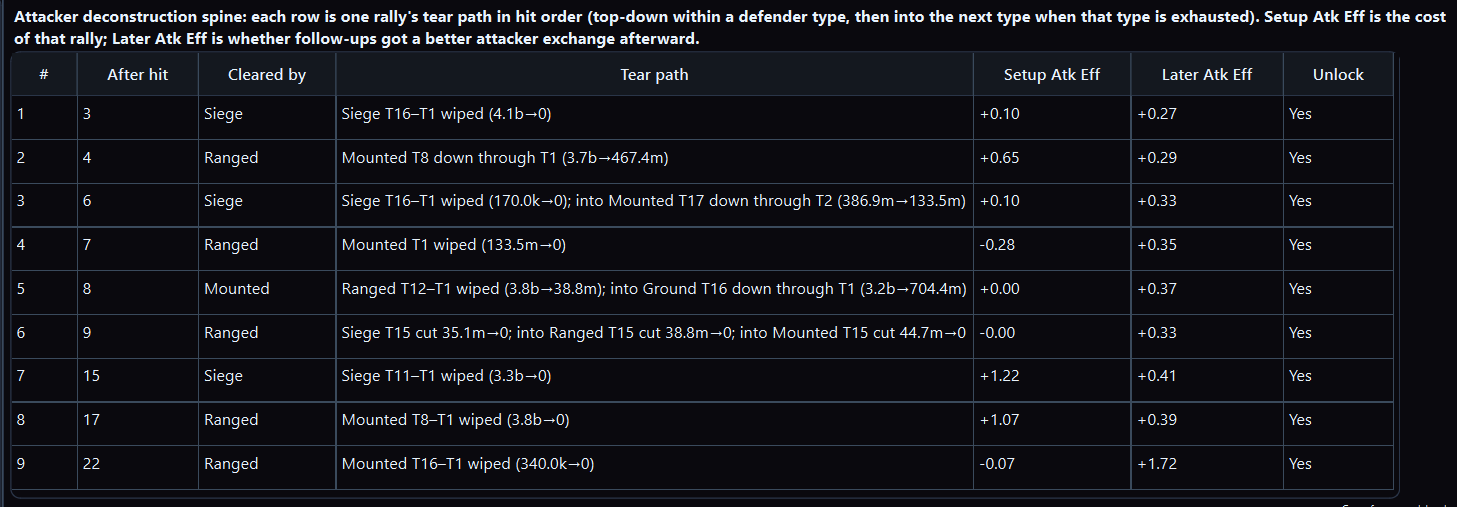
Why this used to be impossible by hand
“Same rally, different result” is the argument every setter has. Without lined-up compositions and the gap between hits, it is only a memory of the fight.
Questions (any wording)
- Which hits on this keep were nearly the same attack into a different wall?
- What had changed on their side between those two — heal, reins, mix?
- Did we keep sending the same recipe after the thing it was for was already gone?
- On the teammate city: which incoming looked like a repeat while our reins had changed?
What a good answer looks like
A pair (or cluster) of hits, what was similar on the attack, what differed on the city, and a refusal to call the better result “optimal play” from two rows. One keep is the parent family.
Common miss
Calling any two ranged rallies a replicate. Near means composition and formation, not “same troop type word.”
Same attack composition, different defending city — only visible with the sequence lined up.
“We sent the same rally” is only a claim until compositions and the gap between hits (heal, reins, missing layer) sit in the library. Fast Read the event, focus that keep, then ask which hits were nearly the same attack into a city that had already changed.
New customers can start with a 7-day trial. Plans start at $14.99/month with full feature access.