Coverage and sampling
The Analyst can only see reports that are in the library. A battlefield summary that looks “thin” is often a sampling story, not a performance story.
By hand people treat the reports they happened to open as the event. That bias is worse when Fast Read ran from one account’s favorited reports: rallies may be complete if you favorited a setter’s reports; solos and other people’s defenses may be holes.
Focus
The whole battlefield first — the first summary is supposed to say what is under-sampled. Then any slice you are about to treat as “the truth.”
Why this used to be invisible
If you never imported the missing fights, you never felt their absence. You felt a short after-action.
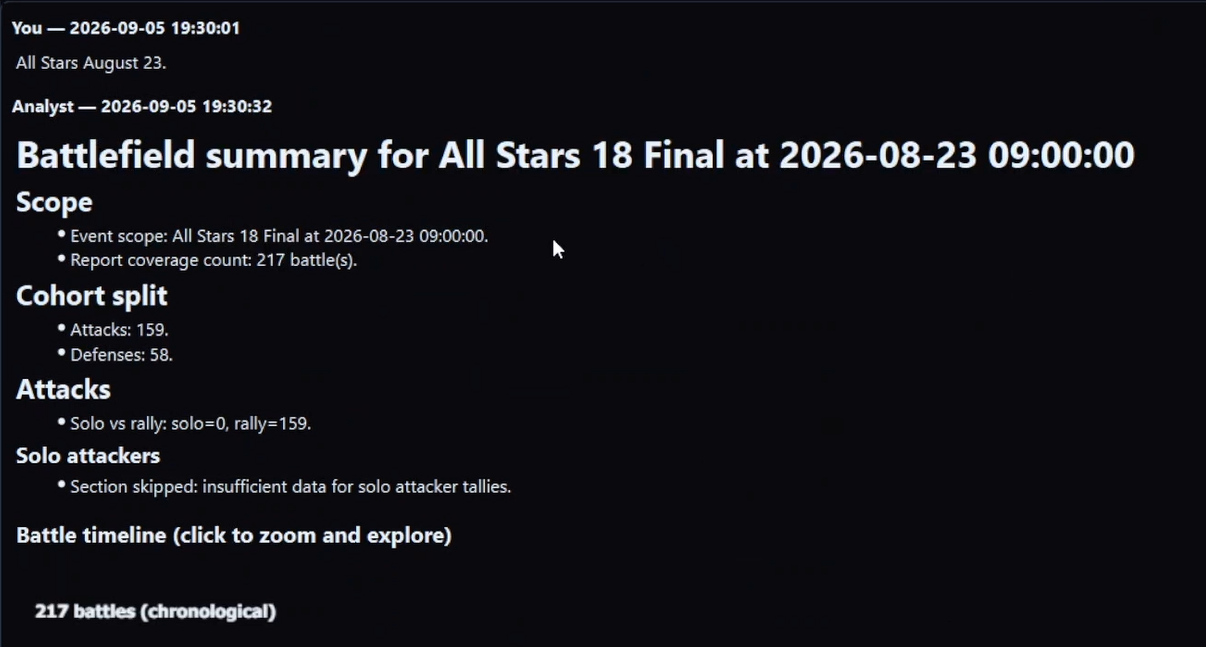
Questions (any wording)
- From the reports we have, what is likely missing?
- Whose mailbox would change this slice — main defenders, a setter, the people who soloed?
- Are we looking at attack-heavy sampling and calling it “we didn’t defend”?
- Is this player’s series short because they sat, or because we never read their joins?
- What should we star and Fast Read before we argue about this keep?
What a good answer looks like
Qualified language: “in this sample,” “from available reports.” Concrete next imports, not a vibe that the data is fine. Missing ≠ didn’t happen. That honesty is part of the reading. Numbers, and the reading.
Common miss
Forcing a confident training or blame conclusion out of eight reports and a loud memory. Depth scales with how complete this battlefield’s set is. Load more of the same event, then ask again.
A thin summary is usually a sampling story — not proof the team under-committed.
The Analyst can only see reports in the library. Favorited setter mail can look complete on rallies and empty on solos and other people’s defenses. Fast Read more of the same event from the mailboxes that actually fought, then open the battlefield again before you train or blame from eight rows.
New customers can start with a 7-day trial. Plans start at $14.99/month with full feature access.