Why this used to be impossible
If you left the Tactica site thinking “it can analyze a battlefield,” that is true and it is the smallest true thing you can say.
A battlefield is not twenty screenshots. It is dozens or hundreds of full reports. Each report is not one opening shot: main, buffs, and details are many screens. Doing that mailbox by hand is thousands of images. Even if you somehow had them, the interesting questions are almost never “what does this one opening screen say?” They are questions across fights: the same keep over an hour, the same joiner as they went dusty, the same city as reins swapped, a troop band versus what it risked.
Those questions were always in the reports. They were not answerable in any reasonable amount of time. That is the scale the Analyst is for.
What “looking at the data” used to mean
Read two or three reports after the event. You learn those fights. You learn almost nothing about the night.
Star the mailbox and never open it. The data exists. The team’s next set is unchanged.
Paste a few screenshots into a general AI. You get a caption of those images. You do not get the mailbox, the layers, the rein movements, or a table over a custom slice. You also do not get a hit-sequence that was assembled from structured reports.
Type a spreadsheet. Troop counts from one fight can be useful. It does not scale to a battlefield, and it rarely keeps buffs, layers, or who entered and left a city between hits. Tactica does not offer a CSV/JSON dump of the library. Analyst tables have a copy button when a slice belongs in a sheet.
Open every report and take notes. This is the honest old method. It is also why almost nobody did the work. Tracking one keep’s incoming, heals, and rein swaps across a pile is a war-room job measured in hours. Doing it for every player, every type, and every “wait, split that by incoming siege” is not a night’s work. It is why those questions never got answered.
What changed (ingest, then analysis — both minutes)
Ingest is how that volume of reports gets into a structured library. Fast Read can import hundreds of full reports you favorited in Evony on MuMu in minutes. Read / Bulk Read works with any ADB-compatible Android emulator and walks every report screen. Details and current limits: how Tactica works.
Analysis is Battlefield Analyst on one loaded battlefield, in minutes. You focus any subset you can name, then ask the question that used to be the weekend.
The Analyst is not “faster captions.” It plans custom work against layers, participants, and time that are already in the library — including views (sequences, movement, comparisons) that ordinary reading cannot practically assemble. It also reads those views: what is worth time, which hit paid, whether a layer is a good train. That is not a second spreadsheet. Numbers, and the reading.
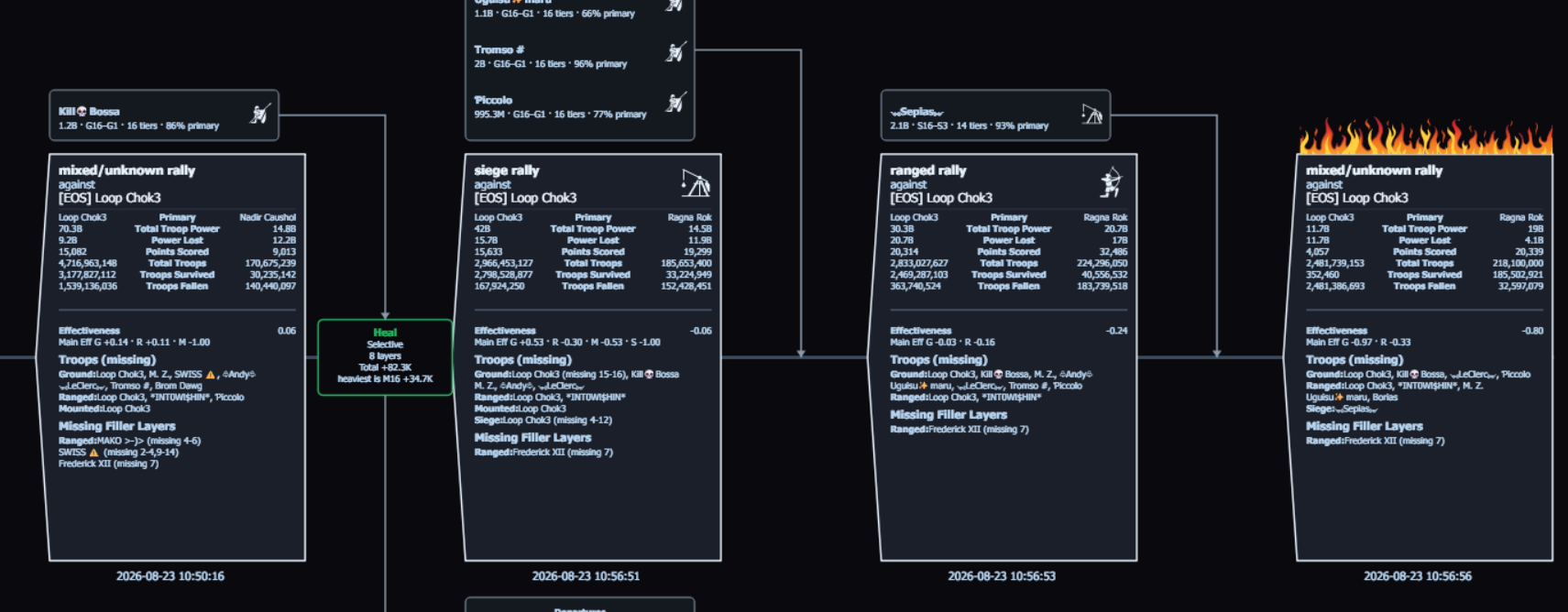
Replace the hand work with a battlefield workflow.
Import the event, let Tactica structure the reports, then investigate the whole battlefield or any slice you can name.
New customers can start with a 7-day trial and begin reading reports within minutes. Plans start at $14.99/month with full feature access; higher-usage plans are available.
The mistake this cookbook exists to prevent
After someone understands that Tactica does analysis, they often stop at:
- summarize the battlefield
- maybe open the keep timeline
- maybe ask who traded well
That is a fine first twenty minutes. It is a tiny fraction of what the library will support.
If a question would have taken a dedicated officer a day of opening reports — lining up the same city, the same joiner, the same troop band, the same ugly results — it is a candidate, not a fantasy. Cut the subset, ask it. If the slice is too thin, the honest answer is coverage, not a shrug that “Tactica doesn’t do that kind of thing.”
The information was always in the reports. You just could not practically examine all of it. Once you can, you can ask questions that were not practical — and some that were not even conceivable — when you could only open reports one at a time. That is why the product’s reach is larger than the examples on the site.
The question atlas is a map of those candidates, not a list of official reports. It is here so you run out of imagination after you run out of time, not the other way around.