Points, Effectiveness, exchange
A reading: who actually traded well on our rallies
Three different ideas get called “we traded well.” If you mix them, every later table is an argument about language.
By hand the only number in the game UI is points scored. That is why people think the scoreboard is cost–benefit. It is not.
Focus
Any slice. Say the lens. Site copy: Effectiveness and the concept page.
The three lenses
Points scored (scoreboard). What the game shows. Does not show what those troops gave up.
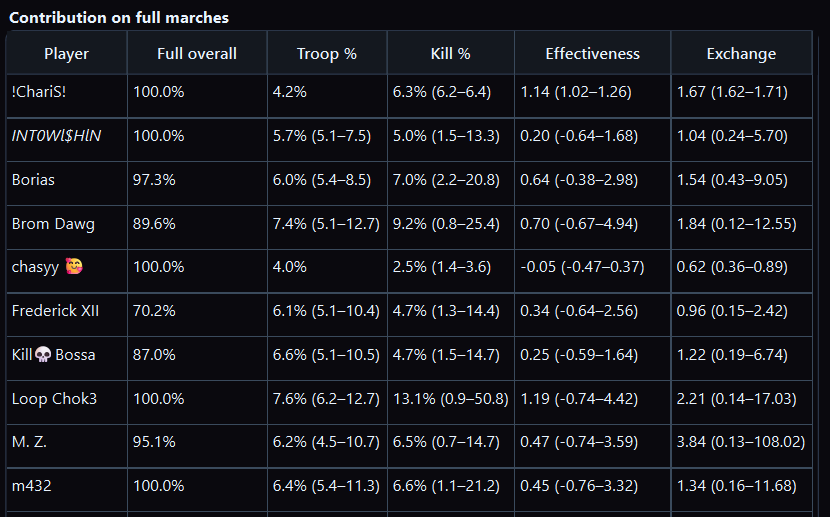
Tactica Effectiveness. (approximate points scored − points given up) ÷ (points you would give up if those troops were a total loss). Own-slice cost–benefit. Higher is better. Around zero is break-even. Points given up and total-loss cost are exact; points scored on a slice are a kill-share estimate. Not a reconstruction of the whole scoreboard. A smaller march can beat a larger one.
Exchange Ratio. Teammate-relative: kill share ÷ points-given-up share. Can move when a dusty teammate joins even if your march did not change. The old name “Effectiveness Ratio” is retired.
Questions (any wording)
- Don’t rank these by scoreboard points — use Effectiveness.
- Who looks good on Exchange Ratio only because someone else was dust?
- Why is the small march beating the big one here?
- Is this ugly result stake or a bad Effectiveness trade?
- Full vs dust — both lenses, labeled.

What a good answer looks like
The lens named. Pieces visible enough to argue. No “best” without saying best-at-what.
You can also name a combination of the library’s numbers (plus, minus, times, divided by, constants) when Effectiveness is not the formula you want. Prefer Effectiveness when that is the trade. Define a measure.
Common miss
Taking an event-wide Effectiveness number as a build order. Cut to the slice and the band. See layers and train-more. Asking the Analyst to invent scoreboard points from kill counts.
Name the lens before you argue “best.”
Scoreboard points, Effectiveness, and a custom exchange are different questions. They need the battlefield loaded and a focus with enough rows to rank. Import the event, open the team or keep cut you care about, then pick the lens — don’t paste totals into another chatbot and ask for a build order.
New customers can start with a 7-day trial. Plans start at $14.99/month with full feature access.