After the summary: your own questions
Once a subset is the current focus, the Analyst is sitting on a pile of structured reports that match your criteria. That is when you ask what you actually came to learn.
The denser reporting you may have gotten on the way in (timeline, team table, one-player series) is one answer to a general question. Your next asks can be narrower, stranger, or more operational than any default.

You do not have to know a “supported report”
There is no menu you are supposed to have memorized. You describe the comparison, the table, the suspicion, or the “show me the rows where…”
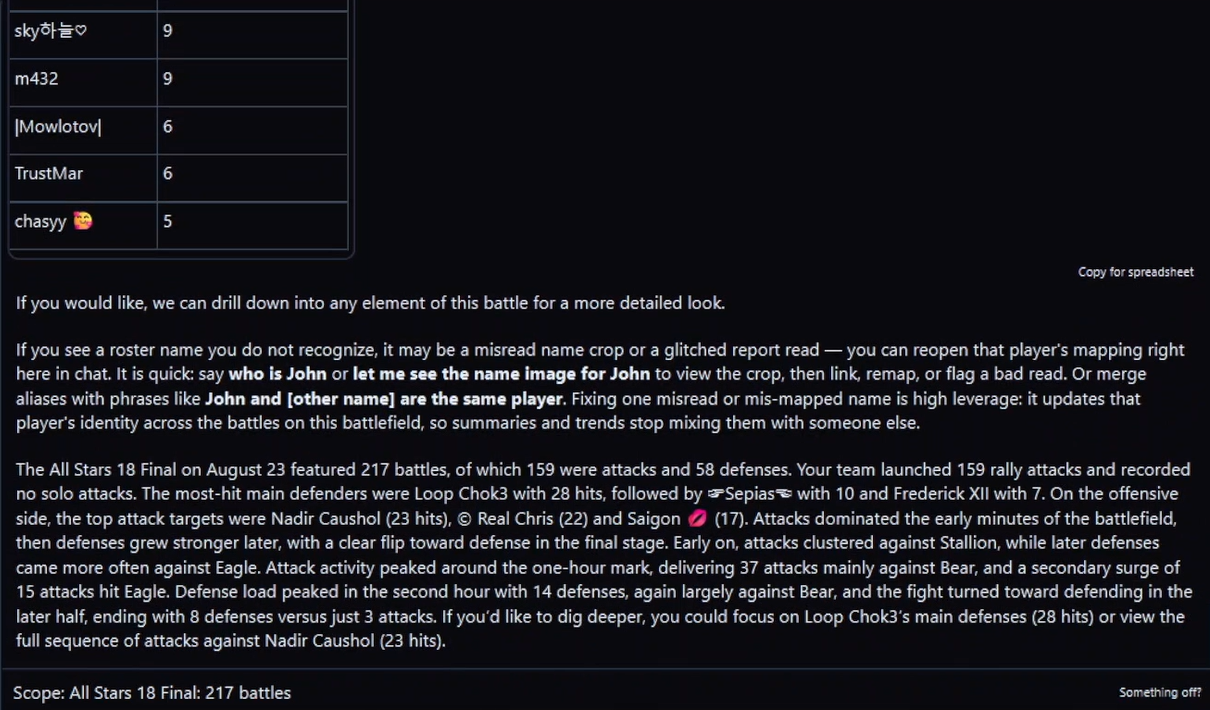
The Analyst plans the analysis against the current focus and runs it on the library. You get narrative plus views — tables, breakdowns, diagrams — that reading the mailbox one report at a time does not practically produce.
You still have to name the thing you want to know. The product is not “you don’t need questions.” It is “you are not limited to our questions.”
Kinds of asks that belong here
These are shapes of curiosity, not product SKUs.
Compare. Ranged T12–T14 vs Mounted T1–T4 on this defense slice. Full joins vs dusty joins on this rally type. Main vs rein on this player’s incoming.
Rank. Who traded best on the current pile, and by which measure. Which layers did the killing. Which fights were the worst exchanges. On a defense focus: which troops to train more of (train more on a defense slice).
Split. Take the look you already have and cut it again without leaving the idea: by incoming troop type, by target keep, by early vs late window.
Explain one row. Why that one rally went so negative. What was missing on the hold that breached. Whether the ugly number is stake (a huge march) or a bad trade. That is a reading, not another column.
Rebuild the table. Different columns. Different grouping. Lowest / typical / highest / spread. A measure you define (plus, minus, times, divided by, constants — nested if you need). Grain down to the layer. Numbers and shapes. Copy button in the Analyst; there is no CSV dump of the whole library.
Chase coverage. If the summary said the slice is thin, ask what is missing — whose reports would change the picture — rather than forcing a confident story out of three fights.
Ask against the focus you have
A precise question on a sloppy focus wastes a turn. “Who traded best?” on the whole battlefield is a different (and usually worse) question than the same words on “our ranged rallies” or “her main defenses.”
If you are still on the whole event and you hear yourself saying “among the ranged rallies,” that is a subset. Name it, take the new summary, then ask the comparison.
If you are already on the right slice, stay there. Staying vs moving.
Measures that are easy to mix up
When you care whether troops worked, say so in terms the library can compute.
- In-game points scored is a scoreboard number. It does not show what those troops gave up.
- Tactica Effectiveness is return versus what that slice put at risk. Higher is better; around zero is break-even. See Effectiveness and effectiveness on the current focus.
- Exchange Ratio is teammate-relative (kill share vs points-given-up share). It can move when a dusty teammate joins even if your march did not change.
If you do not name a measure, the Analyst should pick a defensible one and say which. If it picked the wrong lens, correct the lens. Do not assume “best” means the same thing in every conversation.
What you should not expect in step 4
- A dump of every report in the slice as if that were analysis.
- The Analyst to leave Tactica and finish the job in another chatbot.
- Cross-battlefield omniscience. Stay on this event.
- Exact reconstruction of the whole in-game scoreboard from a custom slice. Effectiveness and related numbers are documented for what they are.
A simple test
If your follow-up only makes sense because you already have a focus (“in these fights…”, “on that keep…”, “among those joins…”), you are using the system correctly.
If your follow-up is “okay now run the other report,” you have slipped back into menu thinking. Ask the question instead.
For a large map of questions people usually never ask — because they could not afford the labor — see the question atlas.
Step 4 is where the product earns the trial.
Compare, rank, split, explain one row, rebuild the table — all of that only runs when a subset is already pinned on a loaded battlefield. If you have been waiting for an after-action where you can ask “in these fights…” without rebuilding the pile by hand, download Tactica, import the next event, take the summary, then stay and ask.
New customers can start with a 7-day trial. Plans start at $14.99/month with full feature access.