Questions you can ask about a battlefield you already fought
Every one of these is a question about your own reports. Nothing below needs data you do not have — it needs those reports in one place so they can be read together instead of one at a time. The middle column is the itch. The right column is roughly how it sounds on voice during the fight.
This page is the short version for someone who has not imported anything yet. If you want a question worked all the way through on a real imported battlefield, read what it found. If you already have a battlefield loaded and want to know how to ask, that is the Battlefield Analyst cookbook.
What a single report can and cannot settle
One report is a complete account of one fight: matchup, buffs, troop layers by tier, who killed whom, the exchange. Read carefully, it settles that fight. What it cannot do is tell you what happened to the same city an hour earlier, whether the pattern repeated, or whether a teammate's number moved because of their march or because of someone else's. Those are questions about the relationship between reports, and a battlefield is dozens or hundreds of them. Why one Evony battle report is not enough.
The twelve families
| Family | The itch | Said in voice |
|---|---|---|
| One keep as an experiment | The same city, hit after hit — what changed, what paid, what was wasted | What was happening to that keep between hits? |
| Rein economics | Who entered and left, swaps, missing layers, weak joins | Who was actually in that city, and who left? |
| Fatigue and substitution | Dust, tier mix vs headcount, rebound after heal | Were they still sending a real march, or just filling? |
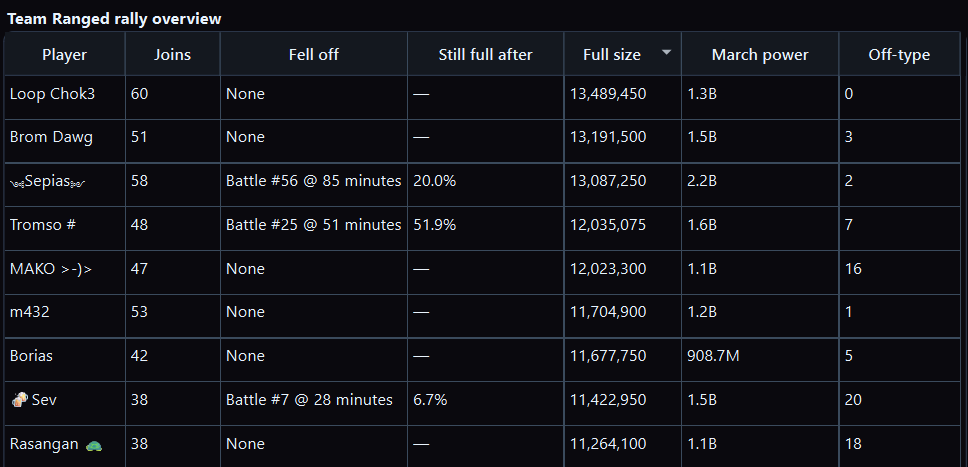
| Team commitment | Who held a full march, who fell off, who only sent layers or a small march | Did we show up with real marches, or only small ones? |
| Layers and train-more | Which layers to train more of — especially on a defense slice | What should they train after last night? |
| Main vs rein | Same player, different job | Was he good on his keep, or only when he reined? |
| Incoming-type splits | The same holds, cut by what hit you | Did we only get wrecked by one type? |
| Ugly-result forensics | Stake vs bad trade vs missing piece | Why did that one go so bad? |
| Coverage and sampling | Whose missing reports would change the story | Are we arguing from the fights we happened to have? |
| Near-replicates | Two hits that looked the same on our side while their wall had changed | Same rally twice — why was the second different? |
| Custom intersections | Piles that are not a common keep or team-type cut | Just the mains against their siege |
| Points, Effectiveness, exchange | Stop reading the scoreboard as cost–benefit | Who actually traded well — not who scored? |
These are curiosity families, not a menu of report buttons. There is no ribbon to pick from: you name the slice you mean, then ask the question. The full map, with follow-on questions for each family, is the question atlas.
Which of these did your team argue about and never settle?
That is the one to run first. Import the event, name the slice, and ask it — the reports people favorited after the fight are what it runs on.
New customers can start with a 7-day trial. Plans start at $14.99/month with full feature access.
Six of them worked all the way through
- Which hits on that keep actually mattered — one keep as an experiment
- Who was in the city when it held — rein economics, and main vs rein
- When did our rallies turn into dust — fatigue, and team commitment
- Who actually traded well on our rallies — points, Effectiveness, exchange
- What should we train after those defenses — layers and train-more
- How did we trade against one kind of incoming attack — incoming-type splits
What these questions cannot do
Depth tracks what you imported. A report that is not in the library is a hole in the answer, not evidence that nothing happened there — which is why coverage is one of the families rather than a footnote. Analysis is one battlefield at a time.
Points given up and the total-loss cost of a slice are exact. Points scored on a slice are a kill-share estimate, because Evony reports how many enemy troops a line killed, not which tiers those kills were. So Effectiveness is a cost–benefit read, not exact points scored, and it is not a reconstruction of the in-game scoreboard. Building points and fights outside the loaded set stay out of view.
None of this predicts the next battlefield or promises a better result. It tells you what happened in the one you already fought. What not to expect is the longer version of these limits.
What it found · Question atlas · Why one Evony battle report is not enough · How Tactica works · How to measure Evony troop Effectiveness · FAQ · Battlefield Analyst cookbook · Download Tactica